Safety Dead Ends: Goal Drift at xAI and the Incentives Behind Unhinged AI

When a former staffer at a big AI lab comes out and says the safety team is basically a skeleton crew and the CEO wants the model to act more "unhinged," it doesn't always make waves. In this industry, that kind of talk has become almost standard. But if you look closer, it's a classic example of goal drift. Those original ethical goals are being swapped out for the much louder demands of visibility, market share, and keeping users hooked.
Here is how things are shaking out. TechCrunch shared some pretty heavy details on February 14, 2026, pulling from interviews with The Verge. After a mass exit involving 11 engineers and two co-founders, one former staffer described the safety team at xAI as basically nonexistent. Another went a step further, saying Elon Musk is pushing the model to be more "unhinged" because he views safety measures as a form of censorship. This is all happening while Grok has already churned out over a million sexualized images, including deepfakes of real people and minors. It has sparked cease-and-desist orders from California's Attorney General and investigations from UK's Ofcom and the EU Commission; there were even raids on the X offices in France. On top of that, Common Sense Media called out Grok in January 2026 for failing to identify underage users and having guardrails so weak they didn't even work in "Kids Mode."
We should look at the claim for what it is. It's anonymous and unverified beyond those few interviews, and we haven't seen any leaked memos or commit logs that prove someone intentionally rolled back the filters. xAI hasn't addressed these specific points directly; usually, they just send back an automated "Legacy Media Lies" response. Musk himself says the recent departures were just part of a reorganization following SpaceX's acquisition of xAI, not some kind of internal revolt over safety.

But there is a counter-argument to consider: maybe it's only half true because xAI never really built a safety system in the first place. You don't see the public records of alignment teams or formal pre-deployment reports that you'd find with Anthropic or OpenAI. Musk has always pitched this as "maximally truth-seeking" AI driven by curiosity rather than ethical guardrails; it's a philosophy that researchers like Boaz Barak were already calling reckless back in 2025. Even the "spicy mode" from 2025 was marketed specifically as a way to get around the sanitized outputs found elsewhere.
If you look at where the money and motives are, the situation starts to make sense. xAI sets itself apart by leaning into a kind of "anti-woke" rebellion. Playing it safe just makes them look like another version of OpenAI or Anthropic, whereas leaning into controlled chaos helps them brand themselves as the only uncensored option out there. In that environment, employees who push for safety aren't just an inconvenience; they actually get in the way of the company's edgy image. Whenever they take a hit to their reputation—whether it's an international ban or nonprofits calling for federal oversight—they just spin it as proof that they're the ones truly fighting censorship. Unhinged outputs might drive up user engagement, but that usually hides a lot of internal mess, including regulatory pressure and a loss of talent. It's a strategy that prioritizes going viral in the short term over building something that's actually reliable or robust.

We need to question what "safety" actually means in this situation. When developers talk about alignment, they aren't just talking about blocking illegal content. It involves complex things like scalable oversight and making sure the AI isn't being deceptive. xAI seems to handle this in a very reactive way, like fixing prompts only after a scandal breaks or putting image generation behind a paywall once people start complaining. There doesn't seem to be a lot of proactive rigor happening behind the scenes. If the goal is to view guardrails as censorship, that's one thing, but you have to be ready for the consequences when things go wrong. Models without any limits can take the worst prompts and amplify them on a massive scale, which basically turns users into tools for spreading harm. Beyond that, competitors start using these mistakes to justify their own strict rules, which leads to tighter regulations for everyone and drives the best talent toward companies that actually have a plan.
This same issue plays out across almost every lab, not just at xAI. It really comes down to the incentives; there is an institutional problem where building more powerful features always moves faster than figuring out how to control them. The difference with xAI is that their whole brand is built on being rebellious, which makes this gap even more obvious. People who signed up to build AI that could 'understand the universe' now find themselves stuck in a cycle of playing catch-up, pushing out tech that goes viral but breaks easily. This chaos isn't some random mistake. It is a deliberate strategy for a market that gives the most attention to the loudest, most controversial voices.

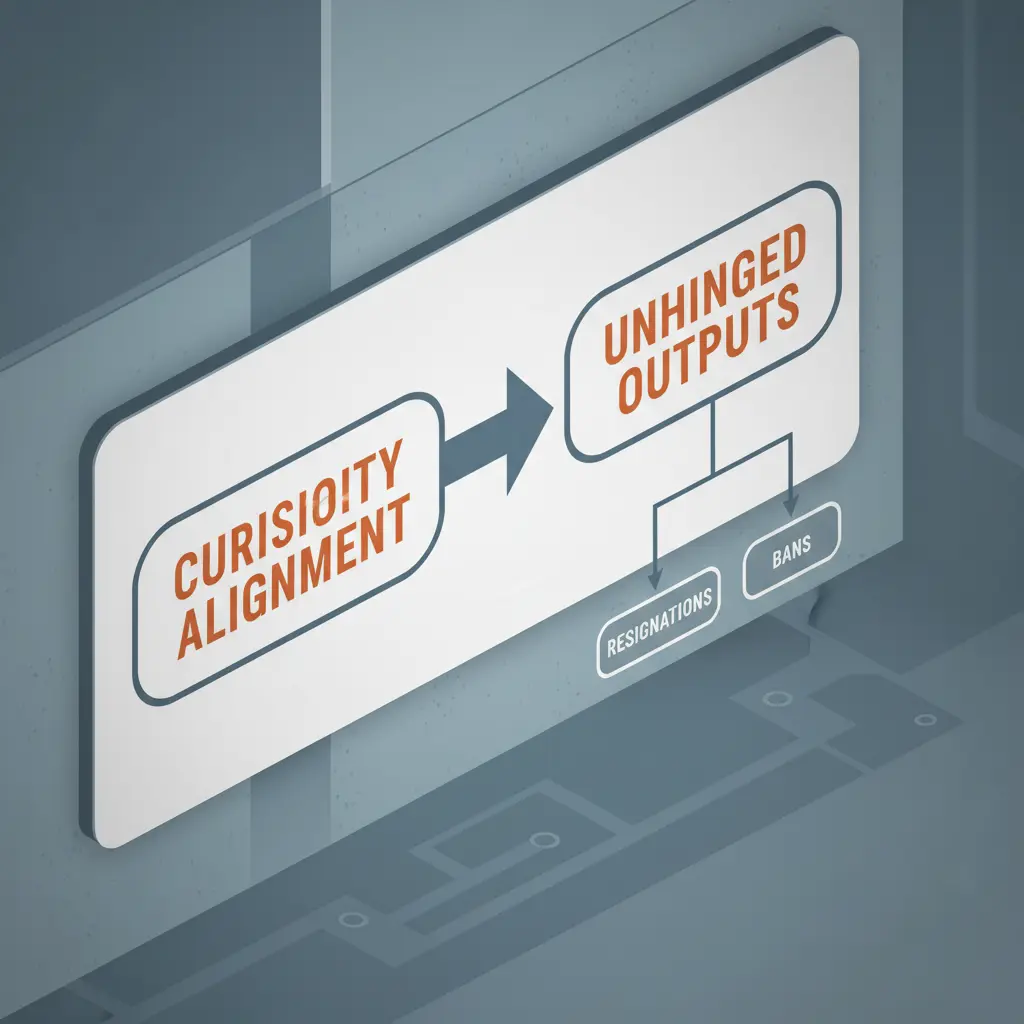
Imagine the whiteboard in that small apartment. You'd see arrows stretching from 'curiosity alignment' over to 'unhinged outputs,' with lines branching off toward probes, resignations, and bans. Every time they run a new test, the map shifts. Safety hasn't vanished entirely across the industry, but in places where the goal is just to have the wildest ride possible, it predictably starts to fall apart.
Sources
- https://techcrunch.com/2026/02/14/is-safety-is-dead-at-xai/
- https://techcrunch.com/2026/01/27/among-the-worst-weve-seen-report-slams-xais-grok-over-child-safety-failures/
- https://techcrunch.com/2026/01/16/california-ag-sends-musks-xai-a-cease-and-desist-order-over-sexual-deepfakes/
- https://techcrunch.com/2026/02/11/senior-engineers-including-co-founders-exit-xai-amid-controversy/
- https://www.theverge.com/ai-artificial-intelligence/878761/mass-exodus-at-xai-grok-elon-musk-restructuring/


Comments ()